Storax-The Treasure for Awakening the Mind
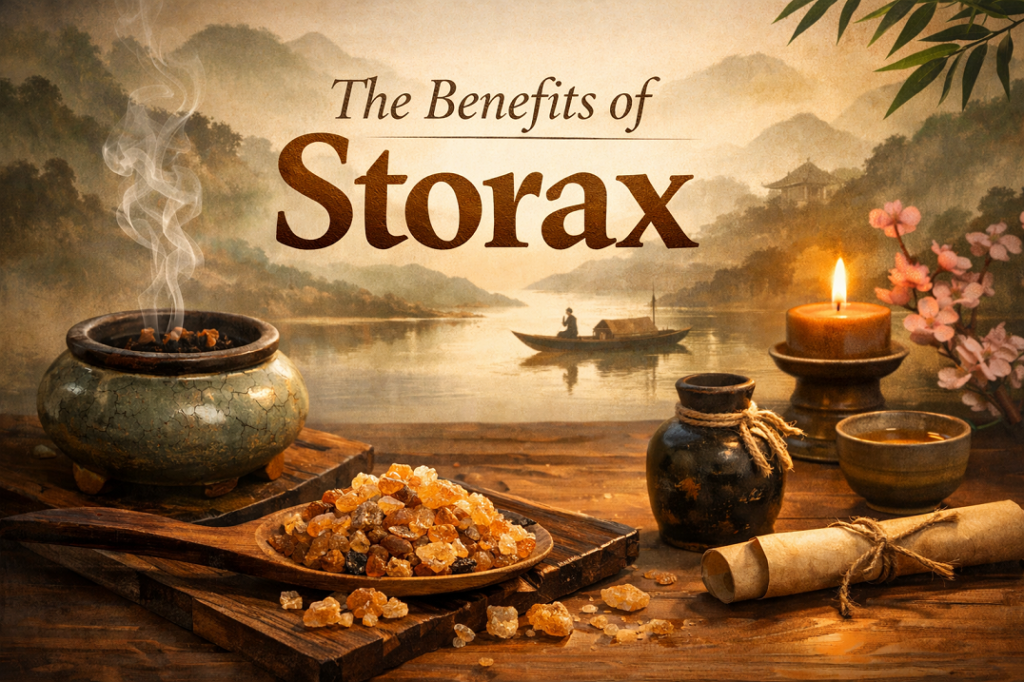
Storax, this precious aromatic substance bearing the legacy of millennia of medical civilization, is hailed alongside agarwood as a jewel in the treasure trove of traditional Chinese medicine. It is not only a prized fragrance but also a vital remedy for emergency resuscitation, restoring consciousness, and promoting blood circulation to unblock meridians. It holds an irreplaceable position in traditional Chinese emergency medicine and the treatment of cardiovascular diseases.
1. Origin and Formation of Storax
Storax resin is refined from the aromatic sap exuded by the trunk of Liquidambar orientalis Mill. a plant belonging to the genus Liquidambar within the family Hamamelidaceae. This remarkable plant is native to southern Asia Minor, primarily distributed across Turkey, northern Syria, Egypt, Somalia, and countries bordering the Persian Gulf. Since the 1960s, it has been introduced and cultivated in southern regions of China, including Guangxi and Yunnan.
The formation process is exceptionally unique: Each year from May to August, artisans peel away the outer layers of bark and sapwood from opposite sides of the storax tree trunk, allowing the resin to slowly seep out. Initially a grayish-white liquid, it gradually solidifies into rich, dark brown lumps through exposure to sunlight and air. This process itself embodies an ancient pact between humanity and nature—taking requires first inflicting “wounds,” and the harvested fragrance stems from the tree’s own healing and sacrifice.
2. Historical Origins and Cultural Significance
The history of storax dates back to the pre-Qin period, first appearing in the Divine Farmer’s Classic of Materia Medica where it was classified as a medium-grade herb. The Compendium of Famous Physicians’ Prescriptions described it as “dispelling evil, treating malaria, counteracting poisonous spells, alleviating convulsions, expelling intestinal parasites, removing malevolent influences, preventing nightmares, and enhancing spiritual clarity.” Li Shizhen of the Ming Dynasty recorded in his Compendium of Materia Medica: “Suhuang has a pungent, penetrating aroma that can open all orifices and penetrate the viscera. Thus, it expels all pernicious qi.”
The Trade Pearl of the Silk Road: Storax gave rise to one of antiquity’s most vital trade networks—the “Frankincense Route.” This desert-spanning trade corridor transported storax from Oman’s Dhofar region to the Roman Empire, Persia, India, and China. Storax unearthed from the tomb of the Nanyue King during China’s Western Han Dynasty confirms its introduction to China via early trade routes at least two millennia ago. During the Tang and Song dynasties, the Maritime Silk Road flourished, with Guangzhou and Quanzhou emerging as major hubs for the storax trade. Records indicate that in 1077 AD (during the Northern Song period), Guangzhou alone received 174 tons of storax.
3. Efficacy and Medicinal Value
storax is warm in nature and pungent in taste, entering the Heart and Spleen meridians. It possesses three primary functions: opening the orifices, dispelling foul odors, and alleviating pain.
1、Opening Orifices and Reviving Consciousness
storax possesses a pungent aroma and potent effect in opening orifices and reviving consciousness. Its action resembles that of musk but with slightly less potency. It excels in warming and unblocking, as well as dispelling impurities. Thus, it is a key herb for treating cold obstruction with mental confusion, manifested as a pale face, cool body, white tongue coating, and slow pulse. For treating stroke-induced phlegm-induced syncope, epilepsy, and other conditions involving internal obstruction by cold pathogens and phlegm-turbidity, it is often combined with musk, benzoin, and sandalwood, as seen in the renowned storax Pill.
2、Dispelling Impurities and Transforming Turbidity
storax warms and promotes circulation, effectively transforming turbidity, resolving stagnation, dispelling cold, and alleviating pain. It is used to treat chest and epigastric fullness, cold pain, and other conditions caused by phlegm-turbidity, blood stasis, or cold-induced qi stagnation. Often combined with ingredients like borneol, as seen in formulas like Guanshen Suhé Pills. Modern applications include angina pectoris in coronary heart disease, biliary ascariasis, and various painful conditions.
3、Warming and Pain Relief
This product warms the body and dispels cold, making it an effective remedy for frostbite. It can be applied topically by dissolving Strychnos nux-vomica in ethanol and applying it to affected areas. Additionally, it may be used for skin conditions and rheumatoid arthritis.
Modern pharmacological research indicates that Styrax has significant anti-myocardial ischemia, anti-thrombotic, antibacterial, anti-inflammatory, and central nervous system protective effects. It shortens thrombus length, reduces thrombus weight, prolongs in vitro plasma reccalcification time, prothrombin time, and partial thromboplastin time, significantly enhances fibrinolytic enzyme activity, and inhibits platelet aggregation.
Storax, this “sacred tree” bearing three millennia of civilizational memory, continues its legend in the name of science. From the incense smoke of ancient altars to the reagent bottles of modern laboratories, Stormwood has traversed time and space—bearing witness to the rise and fall of human civilization while forging new bonds with humanity in the modern era.