Sandalwood Ultimate Guide: Origins, Benefits, Uses, Types & How to Spot Fake
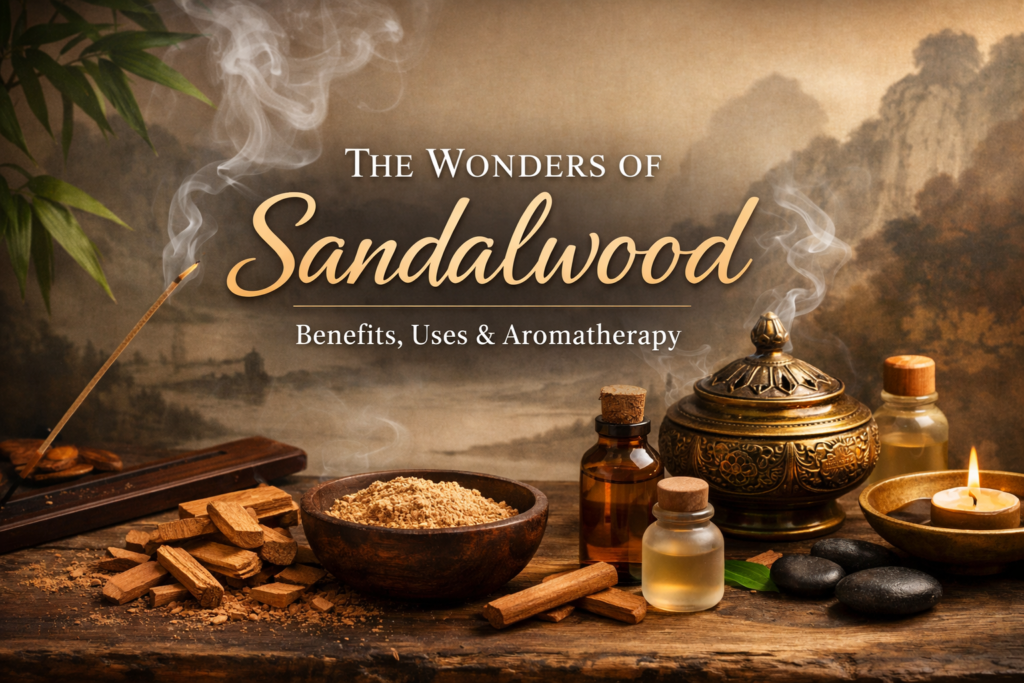
Sandalwood, one of the world’s oldest and most sacred aromatic woods, forms the counterpart to Agarwood in the realm of precious scents. Revered for millennia, its warm, creamy, and soothing fragrance has been central to spiritual rituals, traditional medicine, and artistic expression. This guide explores the complete story of sandalwood, from its unique origins to its modern applications.
1. The Origin of Sandalwood: The Sacred “Parasitic” Wood
Sandalwood is not an ordinary tree; it is a hemiparasitic plant. Its seedlings must attach their roots to specific “host plants” (such as Indian jasmine or lantana) to draw nutrients for several years before they can survive independently. This unique growth process adds to its mystique.
Historical Trace:
- Ancient China: Introduced with Buddhism during the Eastern Han Dynasty, it was transliterated as “Zhan Tan” (旃檀) and was considered the fragrance corresponding to “Prajna” (wisdom).
- Ancient Indian Civilisation: Its use dates back over 4,000 years, making it an indispensable sacred item in Hindu, Buddhist, and Jain ceremonies and yoga meditation. In Sanskrit, it is called “Chandana,” meaning “fragrant wood.”
- Global Trade: Sandalwood was a key commodity on ancient spice trade routes, shipped from India and Southeast Asia to the Middle East, Europe, and China, earning the title “Eastern Gold.”
2. Benefits of Sandalwood: The Key to Body, Mind, and Spirit Harmony
Sandalwood’s medicinal and psycho-spiritual benefits are highly recognised across cultures.
1. Pharmacological Actions (Taking White Sandalwood as an example):
- Antibacterial & Anti-inflammatory: The α-santalol and β-santalol in sandalwood essential oil can effectively inhibit pathogens like Staphylococcus aureusand Candida albicans.
- Calming & Sedative: Its aroma can modulate brain waves, helping to relieve anxiety and insomnia, and is used to assist in treating mild depression.
- Urinary Tract Care: Traditionally used to treat urinary tract infections and cystitis.
- Skin Benefits: Diluted sandalwood oil can help improve dry, inflamed skin and soothe acne.
2. Mind & Energetic Level:
- Meditation Aid: Sandalwood scent is believed to help focus the mind and connect to higher states of consciousness.
- Space Purification: Used in many cultures to purify spaces and dispel negative energy through smoke.
- Emotional Balance: Its warm, grounding character helps soothe emotional fluctuations and bring a sense of security.
3. Uses of Sandalwood: Multidimensional Applications in Life and Faith
1. Religion & Spirituality:
- Carved into deity statues, prayer beads (malas).
- Made into powder or incense sticks for offerings and rituals.
2. Traditional Craft & Art:
- Carving: Its fine grain, medium hardness, and low shrinkage make it excellent for carving statues, art pieces, and seals. Mysore Sandalwood Carving in India is listed as a national cultural heritage.
- Architecture: Historically used in parts of ancient Indian temple structures or interiors.
3. Modern Lifestyle Applications:
- Premium Perfumery: A classic fixative in Oriental and woody fragrance families.
- Aromatherapy: Sandalwood essential oil is popular for stress relief and sleep improvement.
- Skincare & Personal Care: Incorporated into high-end creams, aftershaves, and soaps.
4. Medicinal Use:
- Sandalwood powder or oil is formulated into remedies in Ayurvedic and Traditional Chinese Medicine.
4. Types of Sandalwood: Quality Grades Defined by Origin
Sandalwood quality is primarily determined by its santalol content, with origin being the key factor.
Top-Tier Origins:
- Indian Mysore Sandalwood: Universally acknowledged as the “King of Sandalwood.” Sourced from specific regions in Karnataka, India, trees must be over 60 years old before harvest. Its scent is rich, sweet, with a creamy, milky note and the highest santalol content, offering exceptional longevity. The term “Old Stock” or “Old Roots” specifically refers to aged wood from this region.
- Australian Sandalwood (Santalum spicatum): The current mainstream supply. Its aroma is drier, woodier, and more crisp than Indian sandalwood, with slightly lower santalol content, but it offers better value and is sustainably cultivated.
Other Origins:
- Indonesian Sandalwood: Has a stronger, more smoky, earthy scent, often used for incense sticks.
- Pacific Islands Sandalwood (e.g., Fiji, Tonga): Historically famous, now scarce due to over-harvesting.
Beware of “Fake” Sandalwood:
The market often sees “Australian Sandalwood” or “Santalum” (which is actually Amyris or “West Indian Sandalwood,” fragrant but lacking santalol) being passed off as Indian Mysore Sandalwood. The Core Identification: Genuine, high-quality sandalwood, especially Old Mysore, has a warm, creamy, deep, and long-lasting scent that develops sweet, milky notes upon deeper inhalation—not a sharp chemical smell or a simple woody note.
Conclusion: An Eternal Fragrant Legacy
From the curling smoke of ancient ceremonies to the modern diffuser in urban homes, the fragrance of sandalwood transcends time, continually soothing the human spirit. It is no longer just a religious artifact but a symbol of quality living and inner peace. When purchasing sandalwood products, understanding its origin, grade, and authenticity is not only a pursuit of quality but also a form of respect for this millennia-old cultural heritage.
The true beauty of sandalwood lies in its understated richness and enduring presence—much like truly powerful things, which often exist in the quietest manner and prove their value over time.